

Love Jihad Campaign and Patriarchal Control: How Hindu Nationalist Organisations Police Women and Interfaith Marriages
Caste, Gender and anti-love jihad of the HNOs
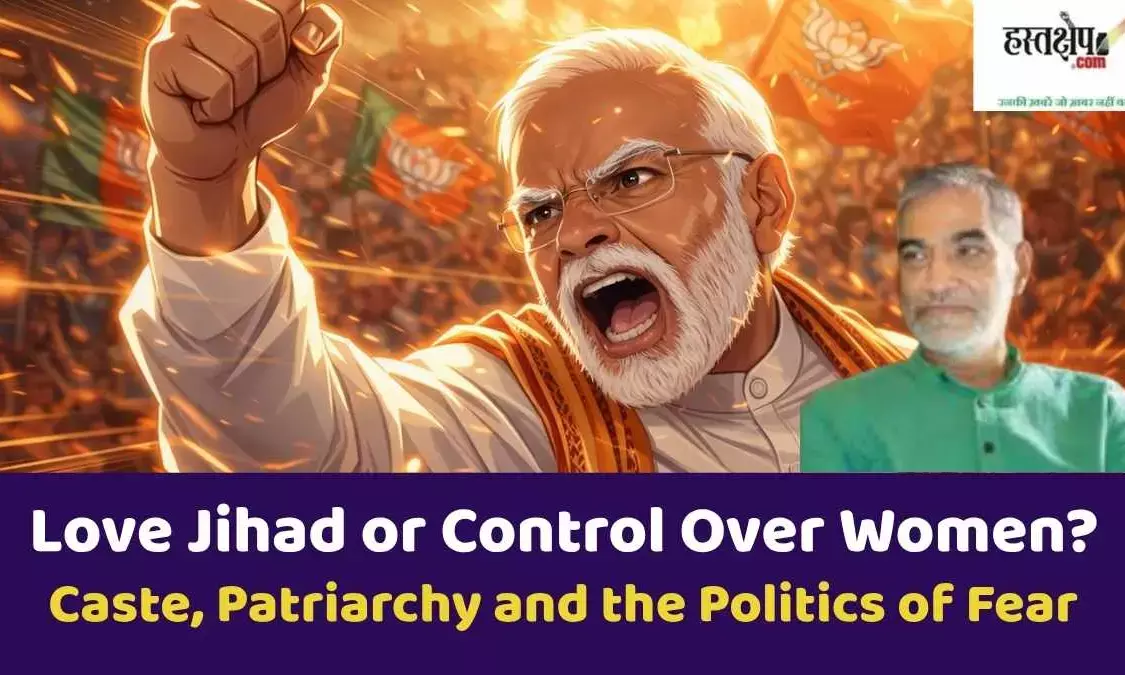
Love Jihad or Control Over Women?
The Hate “Foreigner” Jihad of Hindu Nationalist Organisations Part – 4
How the “love jihad” campaign became a tool for enforcing caste boundaries, controlling women’s choices and opposing interfaith marriages in India’s constitutional democracy....
- Ambedkar’s Theory of Caste and the Politics of Endogamy
- How the “Love Jihad” Narrative Reinforces Patriarchy
- Khap Panchayats, Honour Killings and Social Control
- Gender Justice and the Silence of Hindu Nationalist Organisations
- Interfaith Marriages and the Indian Constitution
- Special Marriage Act and Democratic Freedoms in India
- Urban India, Youth Aspirations and Social Change
- Why Communal Politics Fears Individual Choice
- Democracy vs Feudal Social Hierarchies in Contemporary India
- The Political Project Behind the Anti–Love Jihad Campaign
By Irfan Engineer
The campaign by the HNOs against “love jihad” is not a simpliciter opposition to abduction and rape or even seduction of Hindu women by Muslim men, but it is an opposition to “mixing of blood” between various castes and between the two communities. The caste system prohibits intermarriage to perpetuate hierarchical social division based on birth. Dr Babasaheb Ambedkar, in his essay on “Castes in India”, feels that the prohibition of intermarriages or endogamy is the essence of caste. Ambedkar writes, “Caste in India means an artificial chopping off of the population into fixed and definite units, each one prevented from fusing into another through the custom of endogamy. Thus, the conclusion is inevitable that endogamy is the only characteristic that is peculiar to caste, ...” (emphasis as in original). Caste-based hierarchies cannot be perpetuated without controlling women’s sexuality.
Though the anti-“love jihad” campaign appears to be a campaign against an “enemy community” having evil designs, it is also simultaneously a campaign to strengthen control over Hindu women and assert patriarchal authority by the men of the family and community. The family and the caste decide where they should get married, following the exogamous gotra (prohibited degree of matrimonial relations) considerations and endogamous norms, economic status of the families, agreement over dowry, etc. The khap panchayats enforce these norms and deal out violent and immoral punishments to those who cross these boundaries, which include sexual assault on the woman involved and murder, which ironically is called honour killing. The khap panchayats have drawn the limits – lakshman rekha – which confine the young women of the community and include not travelling after sunset, unless accompanied by a male relative, not carrying mobile phones, restrictions on internet usage, dress code to be followed, and places to be visited. The Muslim community and the khap panchayats impose same restrictions on the women of the community. The anti-love jihad campaign finds ready and willing support among the men in particular and elders in general having daughters in the family as it is a backhanded campaign for restrictions on women’s movements impacting their education, participation in livelihoods, access to family assets, liberties and choices.
HNOs’ anti-love jihad campaign not only targets the ‘enemy community’, it also targets the women of the Hindu community by imagined incidents and exaggerated claims, as in all other campaigns. Without substantiating, according to the campaign, there have been 25000 cases of Muslim boy-Hindu girl marriage in Kerala alone since 2006! Social media, print media and violence are deployed to repeat the inflated figures and so widely broadcast that it is accepted as a factual position. This creates a situation where Hindu women themselves submit to the restrictions imposed by the men of the community and see them as protectors. However, Hindu women need to be protected from Hindu men as well, just as Muslim women face marginalisation and oppression from Muslim men as well. Female foeticide, dowry deaths, sexual assaults by men within the family and close relatives, teasing, pawing and pinching in crowded places, stalking, denying inheritance, discriminating in every field, domestic violence, matrimonial disputes, etc., are but a few examples. The HNOs are not known to have taken up the cause of gender justice and security of women from the men of the family they belong to.
Indian Democracy and Interreligious Marriages
The HNOs want us to believe that there is something devilish about young people getting attracted to each other, developing friendship and choosing their life partners. Will the 100 “smart cities” that PM Modi wants to develop practice gender and communal segregation? If communities inhabit together, they interact, including young people and attractions, which are natural. Interaction between followers of different religions and cultural traditions, in fact, helps people understand themselves better and learn good things from each other. Interaction not only enriches all cultures, but it also produces interesting cultural diversity. Urban cities provide spaces for such interactions, be it neighbourhoods, markets, educational institutions, recreation spaces, work places, public transports, and common struggles to improve quality of life and better environment. Such spaces make segregation of communities and gender extremely difficult if not impossible. Young people will explore the world afresh, unlearn the prejudices and limitations of previous generations and look at the world with their own perspective.The
Indian Constitution gives rights to citizens to profess, practice and even propagate the religion of their choice and have individual liberties and the right to exercise their choice within the confines of law. While the communal elite want those rights to be vested in the elite of the respective community, and to impose a uniform, homogenous and hegemonic culture that restricts the liberties of individuals. The khap panchayats and communal elements want to negate the liberties and choices that individuals are vested with in a democracy.
The people of India emerging out of colonial rule gave themselves a democratic constitution with a vision of social justice, pluralism and embracing diversity. The Constitutional vision, unlike the khap and communal vision, was to allow the individual freedom to choose and fashion their lives, including their life partners. Therefore, in 1954, the Special Marriage Act was enacted for two individuals, whether belonging to different religions, castes, linguistic or ethnic groups or not, they could solemnise their marriage without any religious or traditional rituals with a mere vow to accept each other as their life partners. While the Hindu Nationalist view, as indeed of other communal and caste elite, is to invade and fetter individual liberties and monitor choices of individuals and set up organisations, institutions and mechanisms to force communal and parental choices on people. Gujarat Model empowering the revenue officials to invade personal choices of life partners. Affording liberal choices would steer India towards a stronger democratic country with rich diversity.
To achieve this goal, we will have to build robust educational institutions that encourage students to critically explore the world. The educational programmes should not be confined to schools and colleges, but to the sites where feudal hierarchies are asserting and essentializing religion and caste identities. Education and knowledge come from the sites of struggles to change the world and to empower the marginalised. We must ask the younger generation – the aspirational generation, which was misled to vote for those who put restrictions on individual choices – What would they want – India that is marching towards democracy and liberating the marginalised or feudal hierarchies investing in perpetual supremacist and hegemonic claims, conflicts and stigmatisation of the other. I have no doubt that the aspirational generation would choose the former.
The Hate “Foreigner” Jihad of Hindu Nationalist Organisations Part – 1
Why does Hindutva problematize Love?
Love Jihad Campaign and the BJP
-0-0-0-0-
Irfan Engineer, writer is Director, Centre for Study of Society and Secularism.


